
WELCOME BONUS 300%
UP TO €2000 + 100
FREE SPINS
UP TO €2000 + 100
FREE SPINS
Home → Sports Betting
Sports betting at Very Well Casino
Mistaking Fractional 3/2 for Decimal 1.50
Fractional odds of 3/2, read as "three to two", show only the profit and not the total return, so €1.50 of profit accrues per €1.00 staked. Adding the stake back gives 3/2 + 1 = 2.50 in decimal terms, which on a €10.00 stake pays €25.00, made up of the €10.00 stake plus €15.00 net profit.
Decimal odds of 2.50 already include the stake, and the implied probability is 1 ÷ 2.50 = 40%, while the favourite in the same match is priced at 1.67. A reader who treats 3/2 as 1.50 instead of 2.50 understates the return by €10.00 on that same €10.00 stake, because 1.50 would pay only €15.00.
American odds express the same price from the other side: +150 means 150 ÷ 100 + 1 = 2.50 in decimal, and the favourite at −150 means 100 ÷ 150 + 1 = 1.67. Both convert to the identical €25.00 payout on €10.00, so the confusion costs money rather than changing the underlying price.
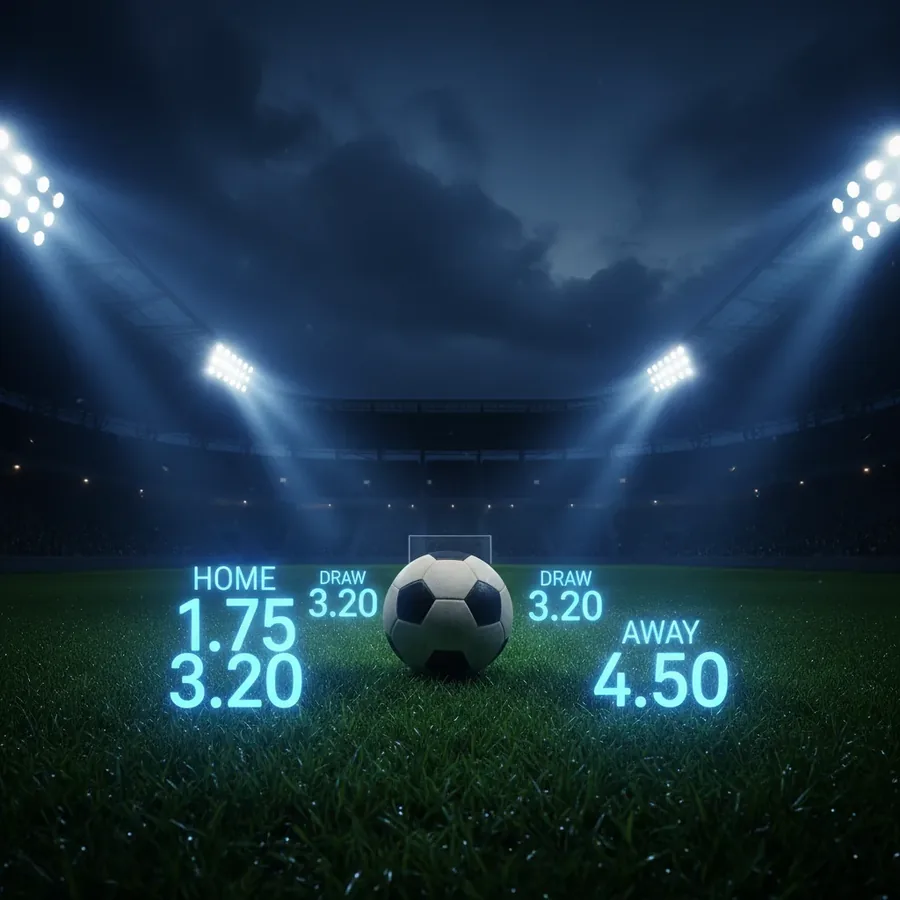
Football: Over 200 Markets on Top Matches
Football carries over 200 markets for top matches, while smaller leagues offer 60–100 markets, and the pre-match 1X2 market runs at a margin of 4–7%, rising to 6–9% live. That margin is what the bettor pays for the book: 100 € of stakes cost 4.00 € - 7.00 € on average in the pre-match 1X2 market.
A half-time/full-time bet covers nine possible outcomes, and 1/1 (home lead at half-time and home win) at 2.40 returns €24.00 on a €10.00 stake. Rarer turnarounds such as 2/1 are often priced at 25.00 to 35.00, so the same €10.00 stake would pay €250.00 - €350.00 if the match swings that way.
Both teams to score ignores the final result: Yes at 1.75 pays €17.50 on €10.00, a net profit of €7.50, and it won at 2:1 but lost at 3:0. An accumulator multiplies selections instead, so 1.50 × 2.00 × 2.50 gives total odds of 7.50 and €75.00 on €10.00, though one wrong pick loses the whole stake.
Confusing -150 With +150: The Consequences
American moneyline odds split into plus and minus values, and −150 means 100 ÷ 150 + 1 = 1.67 in decimal, while +150 means 150 ÷ 100 + 1 = 2.50. On a €10.00 stake the favourite at −150 returns €16.70, whereas the underdog at +150 returns €25.00, a gap of €8.30 for the same stake.
In the football pre-match 1X2 market the margin sits at 4–7%, so 100 € of stakes cost 4.00 € - 7.00 € on average, and the favourite at 1.67 carries an implied probability of 1 ÷ 1.67 = 60%. Reading −150 as if it were +150 inverts the two sides of the book and prices a 60% chance as though it were a 40% chance.
The same distinction appears in the fractional format, where the favourite is priced at 4/6 and the underdog at 3/2. Converting 4/6 gives 1.67 and 3/2 gives 2.50, so the €25.00 payout on €10.00 belongs to the underdog, not to the favourite, and the sign in front of the American number decides which one is which.
CS2 and Dota 2: 40 to 120 Markets
CS2 and Dota 2 sit in the wider esports range of 40 to 120 markets per match, a band that puts them between Tennis at 30 to 60 markets at Challenger events and Ice hockey at 80 to 150 markets per NHL game. The upper end of that band is reached in the biggest tournaments, while smaller events stay closer to the lower figure, so the number of options a player sees depends on the stage of the competition rather than on the game itself.
For a beginner, the practical effect is simple: a match with 40 markets still offers more than one way to bet, because a single map or game can carry its own winner market, a handicap and a total. A match with 120 markets multiplies those choices, which means a new player can start with one clear selection instead of combining several picks on one slip.
An accumulator is the format where that choice matters most: 1.50 x 2.00 x 2.50 gives total odds of 7.50, so a €10.00 stake returns €75.00 and a net profit of €65.00, while one wrong pick loses the whole stake. With 40 to 120 markets available, a beginner can build a smaller slip and keep the total odds closer to 2.00.
Table Tennis: 20 to 40 Markets Per Match
Table tennis offers 20–40 markets per match, well below the 120–200 markets for ATP and WTA tennis matches and the 30–60 seen at Challenger events. The narrower board means fewer ways to split a stake across set and game bets than a Grand Slam fixture allows.
Volleyball provides a close comparison at 40–80 markets per match in the top leagues, with 5–8% in the match winner market and 8–11% on set scores. On 100 € of stakes in a volleyball match winner market, that margin costs 5.00 € - 8.00 € on average, and set bets and point totals dominate the turnover.
Cricket sits higher at 80–150 markets per match, fewer in second-tier T20 leagues, with 5–9% in the match winner market and 8–12% on player bets. A beginner comparing a 20–40 market table tennis board with a 150-market NBA board should note that more markets do not lower the 3–5% handicap and over/under margin on the basketball side.
Sports, markets and margins in the betting offer
| Sport | Markets per Match | Margin | Live Betting | Highlight |
|---|---|---|---|---|
| Formula 1 | 60–120 markets per race weekend, including qualifying | 3–5% on driver head-to-heads, 12–20% on race winner outrights | yes | Head-to-heads are better value than outrights |
| Cricket | 80–150 markets per match, fewer in second-tier T20 leagues | 5–9% in the match winner market, 8–12% on player bets | yes | The margin depends heavily on the format |
| Esports (CS2, Dota 2, LoL) | 40–120 markets per match at major tournaments, 10–25 at small events | 4–7% at top CS2 tournaments, 6–10% for Dota 2 and side markets | yes | Map handicaps and round totals are the core markets |
| Boxing | 25–50 markets per fight | 5–8% in the winner market, 9–13% on round bets | yes | Favourites are often priced below 1.20 |
| Ice hockey | 80–150 markets per NHL game | 4–7% in the main market, 7–10% on period bets | yes | Three-way market covers regulation time only |
| Rugby | 60–120 markets per match in the major leagues | 5–8% in the main market, 8–11% on try scorer bets | yes | Handicap matters more than the plain winner bet |
| Football | over 200 markets for top matches, 60–100 in smaller leagues | 4–7% in the pre-match 1X2 market, 6–9% live | yes | Three outcomes, a draw is always possible |
| Tennis | 120–200 markets for ATP/WTA matches, 30–60 at Challenger events | 3–6% in the match winner market, 6–8% on set and game bets | yes | Two-way market with no draw |
| MMA | 30–60 markets per fight, depending on its place on the card | 5–8% in the winner market, 8–12% on method of victory | yes | Method of victory and round bets are very popular |
CS2 4-7% vs Dota 2 6-10%
CS2 sits in the same esports cluster as Dota 2, and the two are priced apart: CS2 carries a margin of 4-7%, while Dota 2 runs at 6-10%. A margin is the bookmaker's built-in cut, so the gap of roughly 2 to 3 percentage points decides what a bet actually returns. Staking €100.00 on CS2 at a 4% margin costs about €4.00 on average, against €6.00 at the low end of Dota 2.
The upper ends separate the pair further. At 7% on CS2 the average cost of €100.00 in stakes is €7.00, while Dota 2 at 10% takes €10.00 from the same turnover. Over a full season of identical stake sizes that difference compounds quickly, and it is the fastest way for a beginner to see why two esports titles are not interchangeable.
Volume matters as well, and here the comparison with a mainstream sport helps. Tennis offers 120-200 markets for ATP and WTA matches, and CS2 and Dota 2 pricing is read the same way: a lower margin leaves more of the stake in play. A beginner comparing two titles should check the margin before the odds, because a 6-10% range can hide a much worse price than a 4-7% one.
Ice Hockey: 80 to 150 Markets Per Game
An NHL or DEL game carries 80-150 markets, a range that puts ice hockey close to basketball at 150-250 markets for an NBA game including player props. The main market is priced at a 4-7% margin, which is tighter than the 5-8% seen in the match winner market for volleyball. Splitting the 80-150 markets across a single game means dozens of ways to place one opinion.
Period bets are the second layer of that range and are priced at 7-10%. A bettor who puts €100.00 into the main market at a 4% margin gives up about €4.00 on average, while the same €100.00 on period bets at 10% gives up €10.00. That 3 to 6 percentage point gap is the price of narrowing the bet to one period instead of the full game.
The upper end of 150 markets is reached on the biggest NHL and DEL fixtures, and the lower end of 80 on thinner cards. A beginner should treat the main market as the reference point: it is the cheapest of the two layers at 4-7%, and any period or prop bet has to clear the wider 7-10% margin before it is worth the extra risk.
Margins: Football 4-7% vs Tennis 3-6%
Tennis is the cheaper of the two sports on the main market: 3-6% in the match winner market against 4-7% in the pre-match 1X2 market for football. A margin is the bookmaker's cut, so a lower figure keeps more of the stake in play. On €100.00 of stakes the difference is €3.00 at the tennis low end against €4.00 at the football low end.
Live pricing widens both sports. Football moves to 6-9% once the match is running, a rise of 2 percentage points over its own pre-match floor, while tennis stays on a two-way market with no draw and keeps its set and game bets at 6-8%. A €10.00 live football bet accepted after a 3-8 second delay therefore carries a heavier margin than the same stake placed before kick-off.
Market depth explains why football is still the busier sport: over 200 markets for top matches and 60-100 in smaller leagues, against 120-200 markets for ATP and WTA matches and 30-60 at Challenger events. A beginner weighing the two should read the margin first and the market count second, because a 3-6% tennis margin on a Challenger card is not the same product as a 3-6% margin on a Grand Slam match.
Change Odds Format from Decimal to Fractional
Odds formats are a display setting, not a different price, so a decimal 2.00 in the match winner market is the same bet as fractional evens. The underlying figure does not move: a 4-7% margin on a football 1X2 market stays at 4-7% whichever format is shown on screen. Switching the view changes the notation only.
The conversion is worth learning because fractional odds hide the stake inside the number. Decimal 2.20 in a European handicap becomes 6/5 in fractional notation, and a €10.00 stake still returns €22.00, a net profit of €12.00. Tennis at 3-6% and football at 4-7% are quoted the same way once the format is switched, so the margin comparison is unaffected.
For a beginner the practical rule is to pick one format and stay with it. Fractional odds such as 6/5 or 1/2 require a mental step that decimal odds do not, and that step is where errors creep in on a live bet with a 3-8 second acceptance delay. The price of the bet is set by the margin, not by the format chosen to display it.
What odds for a first goal scorer?
A first goalscorer bet pays out on the player who opens the scoring, with the selection settled once the first goal is credited and the rest of the match ignored. Football carries more than 200 markets for top matches, and the opening-goal market sits inside that group, priced separately from the pre-match 1X2 market at 4-7%. The margin on such a niche selection runs wider than the main market because the outcome is settled by a single event rather than the final score.
An accumulator combines several selections on one bet slip, the odds are multiplied, and the slip only wins if every prediction is correct. A first goalscorer pick can be used that way: 1.50 x 2.00 x 2.50 gives total odds of 7.50, so a €10.00 stake returns €75.00, a net profit of €65.00. One wrong pick means the whole stake is lost, which makes a low-probability leg the weak point of the slip.
Decimal odds of 2.50 on a first goalscorer include the stake and imply a probability of 1 ÷ 2.50 = 40%. The same price appears as 3/2 in fractional odds, where the fraction shows only the profit: €1.50 profit per €1.00 staked, and 3/2 + 1 = 2.50 in decimal. American odds express it as +150, meaning 150 ÷ 100 + 1 = 2.50 in decimal, and a €10.00 stake at that price pays €25.00, made up of the €10.00 stake plus €15.00 net profit.
Boxing: 25 to 50 Markets per Fight
A boxing bout at Very Well Casino carries 25 to 50 markets per fight, a range that sits well below the 150 to 250 markets offered on an NBA game and above the 30 to 60 markets listed for an MMA fight. The winner market on a boxing card prices at a margin of 5% to 8%, while round bets run higher at 9% to 13%.
For a beginner, that narrower menu means fewer selections to weigh before placing a bet, and the round-bet margin of 9% to 13% is roughly double the 3% to 5% charged on an NBA handicap. A €10.00 stake on a round bet therefore gives up more to the book than the same stake on a basketball handicap.
The card position also shapes the offer, since a main-event boxing fight lists more markets than an undercard bout, and the 25-market floor applies to the smallest bouts. A beginner comparing boxing with the 30 to 60 markets on an MMA fight sees a similar depth of choice across both combat sports.
Mistaking Double Chance at 1.30 for a Safe Bet
Double chance covers two of the three possible outcomes in one bet, and a 1X selection on a football match pays 1.30, so a €10.00 stake returns €13.00 for a net profit of €3.00. The pre-match 1X2 market on top football matches carries a margin of 4% to 7%, and live prices widen to 6% to 9%.
Beginners often read the 1.30 price as a safety net, yet the payout is only €3.00 on a €10.00 stake, whereas a single home win at odds above 3.00 would return more than triple the stake. The draw is always possible in football, so the two-outcome cover removes one risk but not the margin.
Compare that with an Asian handicap at 1.90 on a €10.00 stake, split as €5.00 on 0 and €5.00 on −0.5: a win pays €19.00, a draw returns €5.00 and a loss returns €0.00. The double chance at 1.30 cannot reach that €19.00 payout on the same stake.
Cricket: 80 to 150 Markets per Match
Cricket matches at Very Well Casino list 80 to 150 markets, with fewer available in second-tier T20 leagues, and the match winner market carries a margin of 5% to 9% while player bets run at 8% to 12%. For a beginner, the 80-market floor on a top fixture is already more than the 25 to 50 markets on a boxing fight.
A €10.00 bet on the match winner at 5% to 9% margin costs between €0.50 and €0.90 in expected value across the stake, while a player bet at 8% to 12% costs €0.80 to €1.20 on the same €10.00. That gap of roughly €0.30 per bet adds up over a season of cricket wagers.
Second-tier T20 leagues narrow the menu, so a beginner who follows a smaller competition sees fewer than 80 markets on offer. A bet builder combining two to eight selections from one cricket match prices at a margin of 10% to 20%, which is higher than the 5% to 9% on the plain match winner.
Driver Head-to-Heads 3-5% vs Outrights 12-20%
Formula 1 race weekends list 60 to 120 markets including qualifying, and driver head-to-heads price at a margin of 3% to 5% while race winner outrights run at 12% to 20%. The outright is a long-term bet settled only after the race, and a league title outright at 8.00 with a €10.00 stake pays €80.00 for a net profit of €70.00.
A beginner weighing the two markets sees the head-to-head margin of 3% to 5% as the tighter price, since a €10.00 stake there gives up only €0.30 to €0.50, against €1.20 to €2.00 on the same stake in a 12% to 20% outright. The qualifying markets also widen the choice across the weekend.
The 60-market floor on a race weekend applies to smaller Grands Prix, while the 120-market ceiling covers the biggest events. Combining a driver head-to-head with other markets in a bet builder carries a 10% to 20% margin, which sits above the 3% to 5% on the duel itself.
Splitting a 10.00 EUR Stake Across Three Doubles
A €10.00 stake split across three doubles of a bet builder means three separate two-selection combinations from one match, and bet builder markets price at a margin of 10% to 20%. A single example of home win, over 2.5 goals and both teams to score together comes to about 4.50, where a €10.00 stake pays €45.00.
If the €10.00 is divided evenly, each double carries roughly €3.33, and the margin of 10% to 20% is charged on every one of the three combinations rather than once. A beginner should note that the combined margin therefore eats into the return three times across the same stake.
For comparison, an outright league title at 8.00 with a €10.00 stake pays €80.00, but that market carries a 12% to 20% margin and settles only after weeks or months. The three-double split settles on a single match instead, which shortens the wait but triples the number of margin charges.
Contact
Live - online chat
Banking









Providers












Very Well Casino 2026